


ArkansasGaming License

Arkansaslicense
Table of contents

Key advantages of Arkansas Gaming License
Progressive Tax System

A tiered tax rate (13%-20%) supports business growth while ensuring fair contributions to the state.
High Revenue Potential

Operators benefit from Arkansas’s growing gambling market, with limited competition in designated locations.
Long License Validity

Licenses are valid for 10 years, reducing renewal hassle and long-term costs.
Legal Market Access

Operate legally in Arkansas’s regulated gambling industry, ensuring compliance and business stability.
Legitimacy You Can Trust

Gain player confidence with a reputable license that ensures fair play, legal compliance, and strict regulatory oversight. A trusted license boosts credibility and attracts responsible gamblers.
Seamless

Operate effortlessly with a license that ensures smooth compliance, fast approvals, and hassle-free transactions. Focus on growth while the regulatory framework takes care of the rest.
Required documents of Arkansas Gaming License
- Curriculum Vitae (CV)

- Utility Bill
- Reference letter from the lawyer or accountant
- Bank reference letter
- Passport

As you prepare key documents for your Arkansas gambling license, we handle the rest—completing all required forms, KYC, AML, and responsible gaming policies, plus the organizational chart. Our streamlined process ensures compliance with Arkansas Racing Commission regulations, minimizing your paperwork and simplifying your licensing journey.
How it works
Obtain a gaming license from 3 months
Navigating the gaming license process can be complex. Here's a streamlined guide to each step.
Looking to operate a gambling business in Arkansas? Here's what you need to know:
License Types: Arkansas offers B2C (for casinos and sports betting) and B2B (for infrastructure providers) licenses.
Costs: $250,000 application fee (50% refundable if denied) and $10,000 renewal fee every 10 years.
Taxes: 13% on the first $150M in net receipts; 20% on earnings above $150M.
Eligibility: Applicants must be 21+, financially stable, and have relevant experience.
Key Requirements: Identity verification, financial records, business registration, and background checks.
Regulations: Strict compliance enforced by the Arkansas Racing Commission, covering audits, operational standards, and responsible gambling measures.
Quick Facts
Renewal Timeline: Every 10 years.
Approval Time: 90-180 days.
Locations Allowed: West Memphis, Hot Springs, Pine Bluff, and Russellville.
Arkansas's regulated gambling framework ensures fair operations while offering lucrative opportunities for operators. Read on for a detailed breakdown of the process, costs, and benefits.
Requirements for Arkansas Gambling License
The Arkansas Racing Commission has set clear guidelines to ensure that only trustworthy and financially capable operators can enter the gambling market. These rules help maintain a secure and transparent industry in the state.
Eligibility
To qualify, applicants must:
Be at least 21 years old
Have a valid business registration with the Arkansas Secretary of State
Be in good standing with the Arkansas Department of Finance and Administration [5][6]
Show relevant experience in casino gaming operations [4]
Required Documents
Applicants need to provide specific documents, as outlined below:
Document Type | Description | Purpose |
|---|---|---|
Identity Verification | Valid driver's license or U.S. passport | Confirms applicant's identity |
Business Documents | Business registration and operational plans | Establishes the business structure |
Financial Records | Detailed financial statements | Proves financial capability |
Location Documentation | Zoning compliance certification | Confirms legal operation location |
Background Check Forms | Fingerprint cards and consent forms | Enables criminal history checks |
All required documents must meet the Commission's standards [2][4].
Financial and Background Checks
The Commission thoroughly evaluates applicants' financial stability and background to ensure compliance:
Financial Requirements:
Proof of sufficient operational funds
Documentation showing legal sources of funding [4]
Background Screening:
Detailed criminal history checks
Fingerprinting for owners, board members, and officers
Examination of professional history
Review of past regulatory compliance [4]
Application Fees
The fee structure is as follows:
Initial application fee: Up to $250,000
Refund: 50% if the application is denied
Renewal fee: $10,000 every ten years [4]
These requirements lay the groundwork for applying for an Arkansas gambling license, paving the way for a deeper look into its potential benefits and challenges.
Pros and Cons of Arkansas Gambling License
Running a gambling operation in Arkansas comes with both opportunities and responsibilities. Below is a summary of the key benefits and challenges of obtaining a gambling license in the state.
Pros and Cons Table
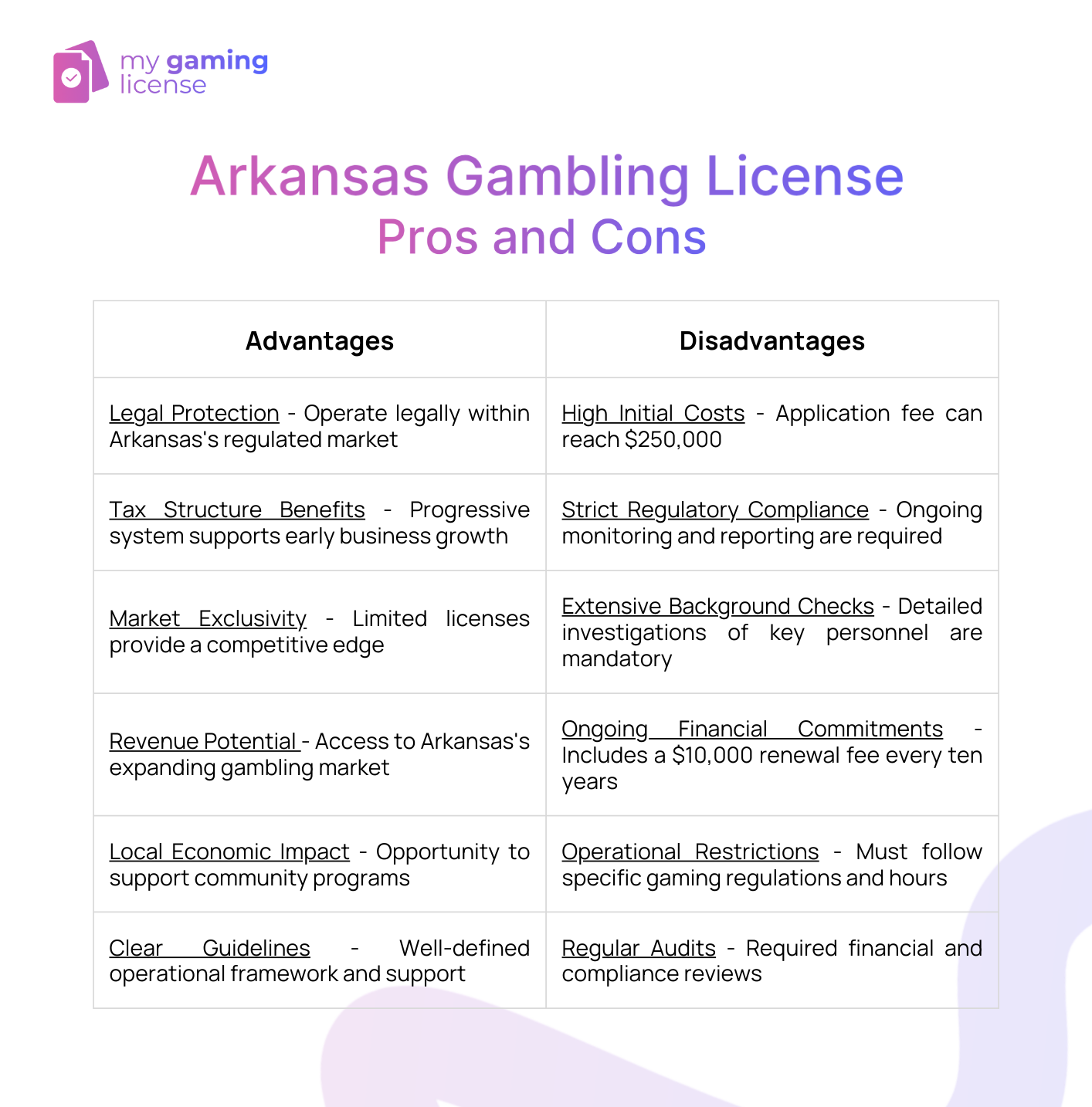
License holders also have an annual obligation to contribute $200,000 to gambling addiction programs. While this adds to costs, it promotes responsible gambling and enhances the operator's reputation.
Arkansas's tax system is designed to help businesses grow during their initial phase while remaining profitable. Additionally, the limited number of licenses creates a competitive advantage, though it also means stricter oversight and operational demands.
For businesses looking to enter Arkansas's gambling market, success depends on having strong financial backing and a commitment to meeting regulatory standards. Carefully evaluating these pros and cons is critical to navigating the state's regulated gambling environment effectively.
How to Apply for Arkansas Gambling License
Preparation Before Applying
Before starting the application process, make sure you’ve gathered all the required documents mentioned in the 'Requirements' section. These must meet the standards set by the Arkansas Racing Commission. It’s a good idea to consult legal experts to ensure everything is in order and complies with the regulations.
Application Submission
When submitting your application, you’ll need to address several key components:
Component | Requirements | Notes |
|---|---|---|
Application Form | Official form from Arkansas Racing Commission | Must be filled out completely |
Initial Fees | $250,000 application fee [4] | Payment required at submission |
Supporting Documents | All necessary documents from the Requirements section | Must be up-to-date and certified |
Merit Criteria | Experience, financial stability, and operational plans | Reviewed by the Commission |
Review and Approval
The Arkansas Racing Commission follows a thorough review process to evaluate applications:
Initial Assessment
The Commission checks all submitted documents for accuracy and completeness, ensuring the applicant has the required casino gaming experience and financial stability.Background Investigation
A detailed background check is conducted as part of the review, focusing on the applicant's history and compliance with regulatory requirements.Final Evaluation
Applications are assessed based on the applicant’s experience, financial health, and operational plans. Common delays occur due to missing documents or insufficient financial evidence.
Successful applicants will operate under Arkansas's tax structure for casino gaming:
13% on the first $150,000,000 in net receipts
20% on receipts over $150,000,001 [1]
Since Arkansas only allows four casino licenses under the Casino Gaming Amendment of 2018 [1][5], the competition is intense. Once you’re approved, you can decide whether a B2C or B2B license fits your business model better.
B2C and B2B Gambling Licenses in Arkansas
Differences Between B2C and B2B Licenses
Arkansas offers two primary types of gambling licenses, each serving a distinct purpose. B2C licenses are for businesses that directly provide gambling services to customers, such as casinos and sports betting platforms. On the other hand, B2B licenses cater to companies that supply the infrastructure - like software, equipment, and payment systems - to support licensed operators.
License Type | Purpose | Audience |
|---|---|---|
B2C License | Running casinos, sports betting, and gaming facilities | End users |
B2B License | Providing infrastructure, software, and technical services | Licensed operators |
Both license types are regulated by the Arkansas Racing Commission, which ensures adherence to state laws and acknowledges the unique operational needs of each.
Requirements for B2C and B2B Licenses
Under Amendment 100 of the Arkansas Constitution, the requirements for these licenses differ significantly. Here's a breakdown:
Requirement Type | B2C License | B2B License |
|---|---|---|
Financial and Operational Standards | High capital, detailed business plans for casinos and hotels | Moderate financial needs, service documentation |
Compliance Checks | Stringent background checks for individuals and corporations | Focus on corporate compliance |
Technical Expertise | Proficiency in managing gaming operations | Advanced tech infrastructure and security systems |
Location and Staffing | Restricted to designated areas, extensive staffing requirements | Flexible location, emphasis on tech skills |
For B2B providers, additional expectations include:
Expertise in gambling-related technology and services
Adherence to Arkansas's regulatory standards
Reliable service performance
Seamless integration with licensed operators
When evaluating B2B applications, the Arkansas Racing Commission prioritizes:
Quality of software and equipment
Strength of security measures
Data protection protocols
Availability of technical support
"Obtaining a B2B gambling license ensures that your business is regulated by an authority with clear compliance rules; this makes your operation more in line with international requirements." - Diane, partner of GFLO Consultancy.
Knowing the specific requirements for B2C and B2B licenses is essential for businesses planning to operate or renew their licenses in Arkansas, ensuring they remain in compliance with state regulations.
Renewing Arkansas Gambling License
Renewal Timeline and Documents
In Arkansas, gambling licenses need to be renewed every 10 years. Operators must file their renewal applications well in advance, as the Arkansas Racing Commission enforces a strict 10-day processing period for submissions that meet all requirements. To renew, operators must provide several key documents, each subject to thorough verification through audits and regulatory checks.
Document Type | Description | Verification Method |
|---|---|---|
Background Checks | Criminal history updates | State and federal databases |
Financial Records | Current financial statements, solvency proof | Independent auditor review |
Compliance History | Past adherence to regulations | Racing Commission assessment |
Operational Reports | Gaming activity and revenue details | Internal audit verification |
Renewal Costs
The Arkansas Racing Commission caps the renewal fee at $10,000, which is a reasonable expense for established operators.
Other potential expenses include:
Preparing and verifying required documents
Upgrading systems
Conducting compliance audits
Professional service fees
The Commission is also inviting public feedback on proposed rule changes for casino gaming license renewals. Comments will be accepted until March 8, 2024.
Staying on top of the renewal process is essential for operators to remain compliant and avoid any interruptions in their operations within Arkansas's regulated gambling market.
sbb-itb-7fe6294
Gambling Regulations in Arkansas
Regulatory Bodies
Gambling activities in Arkansas are overseen by the Arkansas Racing Commission (ARC) and the Department of Finance and Administration's Casino Gaming Section [1]. The ARC is responsible for enforcing compliance, supervising operations, and managing licensing. They focus heavily on ensuring fair gaming practices through regular audits and inspections.
These regulatory bodies work together to ensure Arkansas's gambling laws are enforceable and well-monitored.
Laws and Compliance
The Arkansas Casino Gaming Amendment of 2018 (Amendment 100) legalized casino operations in the state. This amendment permits casino activities in four specific locations: West Memphis, Hot Springs, Pine Bluff, and Russellville.
Regulatory Aspect | Requirements |
|---|---|
Gaming Operations | - Casino games and sports betting (unless federally prohibited) |
Location and Status | - Limited to four authorized locations |
Casino operators must adhere to several important requirements, including:
Submitting regular financial reports and undergoing audits
Ensuring gaming devices meet established standards
Implementing strict security measures
Following local zoning restrictions [4]
The regulatory framework prioritizes both operator accountability and consumer protection. Key areas of focus include:
Ensuring the integrity of gaming operations
Monitoring compliance on a regular basis
Verifying financial transactions
Enforcing robust security protocols
This structure provides a solid foundation for fair and transparent gambling operations in Arkansas, supporting a well-regulated and thriving industry.
Costs and Time for Arkansas Gambling License
Costs Overview
Getting a gambling license in Arkansas involves a substantial financial commitment. The application fee is $250,000, with half of it refunded if the application is denied. License renewals cost $10,000 and are required every 10 years [4].
Fee Type | Amount | Notes |
|---|---|---|
Initial Application | $250,000 | 50% refundable if denied |
License Renewal | $10,000 | Required every 10 years |
Gaming Tax (First Tier) | 13% | On the first $150,000,000 |
Gaming Tax (Second Tier) | 20% | On receipts above $150,000,001 |
Arkansas applies a tiered tax rate to net casino gaming receipts: 13% on the first $150 million and 20% on amounts above that [1]. Operators also need to account for additional expenses, such as:
Contributions to gambling addiction programs
Compliance and regulatory requirements
Maintenance of security systems
Staff training and certifications
These costs are essential to maintaining compliance and running a successful operation.
Approval Timeline
The licensing process is broken into three main steps:
30-day application window [4]
Document verification
Merit-based evaluation
The total processing time depends on factors such as:
Accuracy and completeness of submitted documents
The number of applications being processed
Background check timelines
How quickly applicants respond to additional requests
To avoid delays, ensure all required documents - like financial statements, background checks, and operational plans - are ready and meet the Arkansas Racing Commission’s standards before submission.

Conclusion
Since the 2018 constitutional amendment, Arkansas's gambling industry has grown significantly. In 2023, casinos generated $686.6 million in gross gaming revenue, contributed $1.62 billion to the state's economy, and supported over 9,000 jobs. This growth is supported by the Arkansas Racing Commission's oversight, ensuring a well-regulated and steadily expanding market.
The state's tiered tax structure plays a key role, with rates set at 13% for the first $150 million of net casino gaming receipts and 20% for earnings beyond that [1]. Major projects like the $300 million Legends Resort & Casino underscore the industry's potential for further economic impact and long-term development.
Arkansas's success in the gaming sector is rooted in its strong regulatory framework. This system strikes a balance between fostering business growth and enforcing strict compliance, creating a stable environment for legitimate gambling operations to thrive.
For businesses looking to enter this market, understanding Arkansas's regulatory landscape is critical. The licensing process is thorough but offers clear opportunities for dedicated operators. Navigating these rules effectively is essential for succeeding in the state's competitive gambling industry.
WHY MGL?
Here are 5 reasons why we are the best fit for your project

1 form
Just one form to fill out — we handle everything else.

30 Minutes
All we need from you to kickstart the process.

1-3 Days
Fast company formation so you can start using your business immediately.

6-7 Weeks
Get your casino licensed.










FAQ
We'll answer
any questions you have
Everything you need to know about Our company. Can't find the answer you're looking for? Please chat to our team.
The Commission mandates an annual contribution of $200,000 to fund gambling disorder treatment and education programs.
The Arkansas Racing Commission and the Department of Finance and Administration are responsible for overseeing gambling activities and ensuring compliance.
Licenses are valid for 10 years. Be sure to submit your renewal application at least six months before the expiration date.
Head to the Costs section for a full breakdown of application fees, renewal charges, and tax details.
Check the Requirements section for details on age, legal, and financial qualifications that applicants need to meet.
Ready to start future online casino?
Navigating the gaming license process can be complex. Here's a streamlined guide to each step