


CroatiaGaming License
Croatialicense
Table of contents

Key advantages of Croatia Gaming License
15-Year License Validity
Long-term stability with a 15-year license, reducing renewal concerns.
Access to EU Market

Allows expansion into other European jurisdictions with regulatory alignment.
EU-Compliant Regulation

Strong legal framework enhances credibility and player trust.
Diverse Gambling Options

Covers casinos, sports betting, and online gaming under a structured system.
Required documents of Croatia Gaming License
- Curriculum Vitae (CV)

- Utility Bill
- Reference letter from the lawyer or accountant
- Bank reference letter
- Passport

While you prepare the necessary documents, including company registration details, certified identification for owners, proof of sufficient capital, and a comprehensive business plan, we handle all required application forms, develop and implement policies such as Know Your Customer (KYC) and Anti-Money Laundering (AML) in compliance with Croatian regulations, and prepare the organizational chart, eliminating the need for you to manage extensive paperwork.
How it works
Obtain a gaming license from 1 months
Navigating the gaming license process can be complex. Here's a streamlined guide to each step.
Interested in operating a gambling business in Croatia? Here's what you need to know upfront:
Regulator: Ministry of Finance oversees all gambling activities under the Law on Gambling (effective since 2015).
License Validity: 15 years with annual fees of 3 million HRK (~$431,648).
Requirements:
Minimum share capital: 4 million HRK (~€530,891).
Bank guarantee: 3 million HRK.
Local presence: Physical office and servers in Croatia.
Taxation:
5% on betting turnover.
15% of gross gaming revenue (GGR) for online casinos.
Progressive tax (10%-30%) on player winnings.
Types of Licenses:
B2C: Direct gambling services like online casinos and sportsbooks.
B2B: Support services like software and payment systems.
Application Timeline: Approval takes about 30 days, with licenses issued within 60 days of agreement signing.
Quick Pros and Cons
Pros:
EU-compliant regulations boost credibility.
Long-term license validity (15 years).
Access to Croatia’s growing gambling market.
Cons:
High entry costs and operational demands.
Strict compliance and audit requirements.
Taxes on player winnings may deter high-stakes gamblers.
Whether you're a B2C operator or a B2B service provider, meeting Croatia's strict financial and technical requirements is key to entering this regulated market. Keep reading for a step-by-step guide on the application process, renewal details, and compliance rules.
Croatia Gambling License Basics
Croatia's gambling industry operates under the oversight of the Ministry of Finance, guided by the Games of Chance Act, introduced in 2015. This legal framework ensures a controlled environment for both traditional and online gambling activities.
The Ministry of Finance is responsible for licensing various gambling operations, including lotteries, sports betting, slot machines, traditional casino games, and online gambling platforms. However, the lottery sector is exclusively managed by the state-owned Hrvatska Lutrija, while private operators can participate in other sectors.
Market Size and Growth
Croatia's gambling market is on track to grow at an 8.4% compound annual growth rate (CAGR) from 2024 to 2030. By 2027, revenues are expected to surpass $567.5 million, thanks largely to the country's thriving tourism industry.
Licensing Structure
The Ministry of Finance limits the number of licenses issued: 20 for casinos, 20 for betting, and 55 for slot machines. Each license is valid for 15 years.
Regulatory Framework
The Ministry oversees all aspects of regulation, including licensing, financial compliance, anti-money laundering protocols, and regular audits to ensure operators meet legal standards.
Enforcement and Penalties
Non-compliance can lead to severe consequences, including fines ranging from HRK 50,000 to 500,000, imprisonment of up to 8 years, or fines for players between HRK 10,000 and 50,000.
Cryptocurrency Integration
The gambling sector in Croatia has started embracing cryptocurrencies, providing operators with more options while maintaining adherence to regulatory requirements.
"The Croatian land-based and online gambling falls under the purview of the Ministry of Finance."
Gaining a clear understanding of the licensing process and regulatory environment is essential for anyone looking to enter Croatia's gambling market.
License Requirements
This section breaks down the key steps and conditions operators must meet to secure a gambling license in Croatia. These rules are designed to ensure a safe and transparent gambling environment for both businesses and players.
Company Setup Rules
To operate legally, businesses must establish a registered entity in Croatia, maintain a local office, comply with tax regulations, and submit a detailed 3-year business plan outlining their strategies.
Here’s the minimum share capital required for different gambling categories:
Gambling Type | Minimum Share Capital (EUR) |
|---|---|
Casino Games | 530,891.23 |
Betting Operations | 530,891.23 |
Slot Machine Games | 265,445.62 |
Financial Obligations
Operators face several financial requirements:
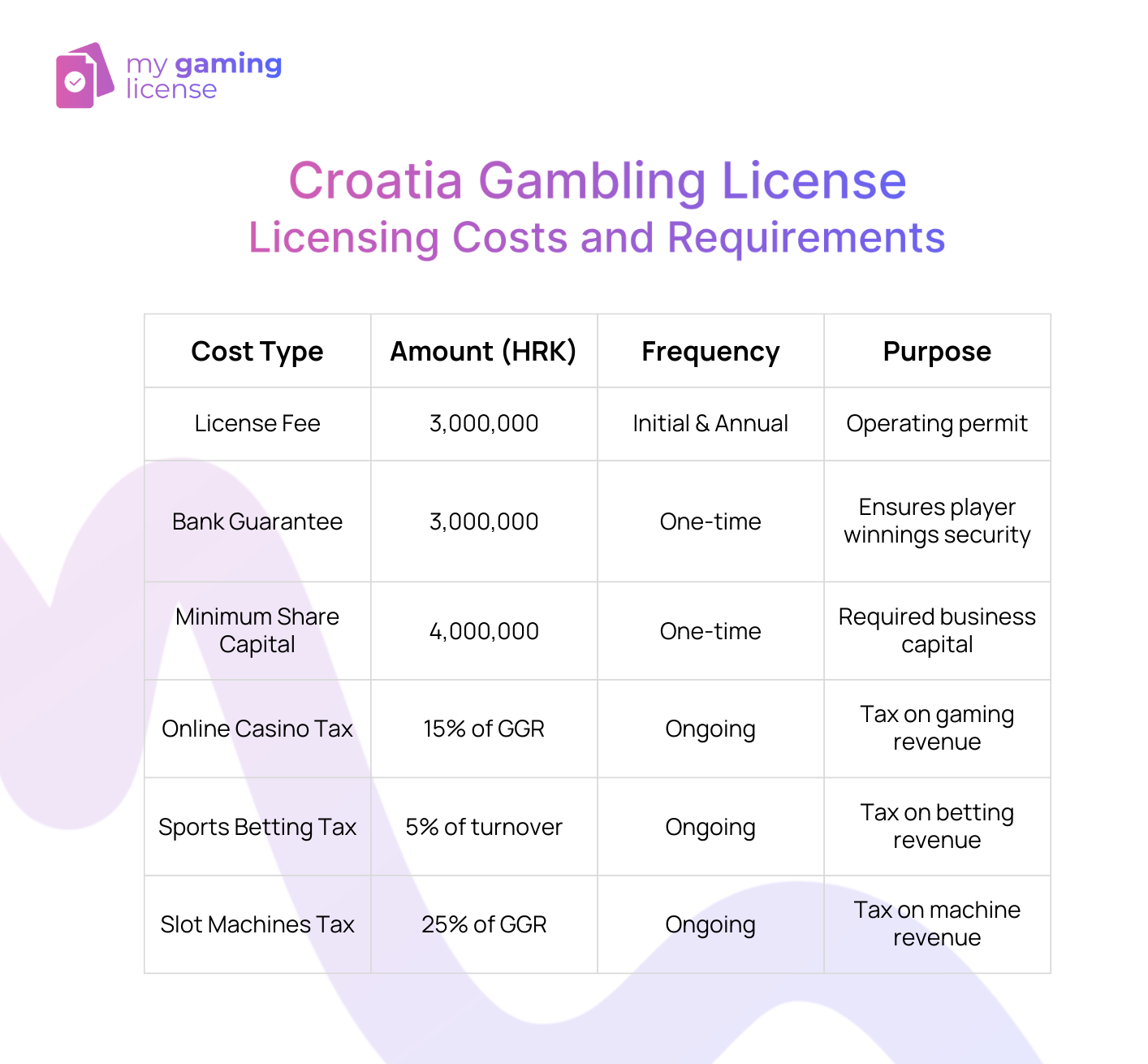
A license application fee of 3 million HRK
A 3 million HRK bank guarantee to cover payouts
An annual license fee of 3 million HRK
Tax rates differ based on the type of gambling service:
Online casinos are taxed 15% of net profit
Online bookmakers pay a 5% tax
Technical Standards
Operators are required to host their servers in Croatia, use approved gaming software, and implement strong data protection measures. Regular audits by laboratories authorized by the Ministry ensure compliance and security. All gaming equipment and software must also be certified by these laboratories, with strict safeguards in place to protect player data and financial transactions.
Once these conditions are met, operators can move forward with the application process, which includes submitting extensive documentation and undergoing thorough compliance checks.
Pros and Cons of Croatia Licensing
The Croatian gambling license comes with both opportunities and challenges that operators need to evaluate carefully before entering this market.
Benefits
Running a gambling operation in Croatia's regulated market offers several key advantages:
Boosted Trust: Croatia's EU-compliant regulations help operators build trust and credibility among players.
Long-Term License: With a 15-year license validity, operators gain a stable foundation for their business.
Access to the EU Market: As an EU member, Croatia provides a stepping stone for potential expansion into other European markets.
Operator-Friendly Tax Rates: Taxation is competitive, with 5% for betting and 15% for casino gross gaming revenue (GGR).
Drawbacks
However, operators should be aware of some notable challenges:
High Entry Costs: Steep capital and licensing requirements may deter smaller operators.
Operational Demands: The need for a physical presence and locally hosted servers adds to costs and logistical hurdles.
Intensive Compliance Work: Adhering to technical regulations and undergoing regular audits requires significant resources.
Tax on Winnings: The tiered tax system on player winnings could discourage high-stakes gamblers, potentially impacting revenue.
Before applying for a Croatian gambling license, operators need to weigh these pros and cons carefully. The application process itself is detailed and requires a solid understanding of compliance requirements.
License Application Steps
Getting a gambling license in Croatia involves a clear process managed by the Ministry of Finance. Here's a straightforward guide to help you navigate the steps and meet the requirements.
Document Checklist
Make sure you have these documents ready before applying:
Company registration papers, proof of a Croatian business presence, and evidence of at least 4 million HRK in share capital
A comprehensive business plan and operational strategy
Croatian bank account details and proof of license fee payment
Technical documentation and independent testing certification for gaming systems
Documentation on software compliance and security protocols
Once you've gathered everything, you're ready to move forward with the application.
Application Process
1. Initial Submission
Submit your completed application through the Ministry of Finance's official licensing portal.
2. Technical Verification
The Ministry will evaluate key aspects like information security, server location within Croatia, gaming software certification, and data protection measures.
3. Due Diligence Review
A detailed review of your company's ownership, finances, technical setup, and legal compliance will be conducted.
Getting Your License
After your application is approved, follow these final steps:
Provide a 3 million HRK bank guarantee to ensure player payouts are secured
Set up your local operations and finalize your technical infrastructure
Receive your 15-year license from the Ministry of Finance
Licensed operators must also comply with regular audits and keep the Ministry updated on key personnel changes and financial statements.
Next, it's important to understand the differences between B2C and B2B licenses in Croatia to determine the right path for your business.
B2C vs B2B Licenses
Croatia's gambling licensing system separates licenses into two categories: B2C licenses for businesses serving consumers directly and B2B licenses for those supporting operators. Deciding on the right license is a crucial step in navigating the application process.
Key Differences
Aspect | B2C License | B2B License |
|---|---|---|
Primary Function | Direct gambling services to consumers | Support services for operators |
Share Capital | Minimum 4 million HRK | Not specified |
Bank Guarantee | 3 million HRK required | Not required |
Annual Fee | 3 million HRK | Lower, varies by service type |
Duration | 15 years | Determined case by case |
B2C License Details
B2C licenses are designed for businesses like online casinos and sportsbooks that provide gambling services directly to players. To qualify, companies must:
Set up a business entity and physical presence in Croatia.
Submit detailed technical documentation.
Undergo regular audits.
Implement player protection measures.
Follow anti-money laundering protocols.
It’s worth noting that Hrvatska Lutrija LLC, a state-owned entity, holds exclusive rights to operate lottery games but can also offer other gambling services.
B2B License Framework
B2B licenses, though less explicitly defined in Croatian law, are tailored for service providers such as software developers, payment processors, and gaming platform creators. These businesses must meet high technical standards and align their services with operators' regulatory requirements.
Financial Considerations
B2C operators face significant financial commitments, including:
Initial Investment: 4 million HRK in share capital.
Annual Licensing Fee: 3 million HRK (around $431,648).
Bank Guarantee: 3 million HRK.
In contrast, B2B providers generally deal with lower financial requirements but must still show financial stability and technical expertise.
Compliance Requirements
B2C operators must adhere to strict compliance rules, including:
Reporting regularly to the Ministry of Finance.
Implementing robust player protection measures.
Obtaining mandatory technical certifications.
Hosting servers locally.
Ensuring data protection compliance.
Choosing the right license type is key to aligning your business with Croatia's regulations, whether you're offering services directly to players or supporting other operators.
sbb-itb-7fe6294
License Renewal
Renewing a Croatian gambling license requires careful planning to avoid disruptions. With licenses valid for 15 years, operators need to prepare well in advance to ensure uninterrupted operations.
Key Renewal Requirements
Requirement Category | Details | Timing |
|---|---|---|
Documentation | Updated company details, proof of tax compliance, and a 3-year business plan | Before the current license expires |
Financial | HRK 3 million license fee, technical audit costs, and compliance expenses | Annually |
Technical | Security audits and compliance checks | Ongoing |
Operational | Verification of physical presence and server location | Continuous |
Staying Compliant
The Ministry of Finance regularly audits operators to confirm:
Financial stability and accurate reporting
Integrity of technical systems
Effectiveness of anti-fraud measures
Adherence to money laundering prevention protocols
To meet these standards, operators must:
Submit regular financial reports
Follow technical regulations
Update security protocols
Maintain infrastructure reliability
Compliance Checklist
Renewal success depends on meeting several key criteria:
Submitting updated documentation
Paying required fees and fulfilling financial obligations
Adhering to technical and security standards
Conducting regular system audits
Meeting operational requirements
B2C operators must maintain the annual HRK 3 million license fee and provide a bank guarantee. B2B providers face additional service-specific obligations.
Consequences of Non-Renewal
Failing to renew a license can lead to severe consequences, including:
Suspension of operations
Financial penalties
Potential legal action
Damage to reputation
Technical Standards
Renewal also requires meeting updated technical standards, such as enhanced security protocols, regular system audits, and proper server infrastructure maintenance. These measures ensure operators maintain high standards throughout the license period, emphasizing continuous compliance rather than periodic efforts.
Understanding and navigating the renewal process is crucial for staying compliant and thriving under Croatia's gambling regulations.
Croatian Gambling Laws
Croatia's gambling laws provide the foundation for a regulated and secure gambling environment. These laws are governed by the Law on Gambling, which has been in effect since January 1, 2015. Oversight is handled by the Ministry of Finance, the main regulatory authority.
Core Legal Framework
Croatia's gambling regulations cover several critical areas:
Aspect | Regulation Details | Penalties for Non-Compliance |
|---|---|---|
Licensing Control | 15-year licenses required | Fines up to HRK 500,000 |
Technical Requirements | Servers must be located in Croatia | License suspension or revocation |
Financial Operations | Operators must meet minimum capital requirements | Operational shutdown |
Player Protection | Measures like age verification and responsible gaming policies | Potential criminal charges |
Tax Structure
Taxation depends on the type of gambling activity:
5% of turnover for betting
15% of gross gaming revenue (GGR) for casinos
25% of GGR for slot machines
Progressive tax rates (10–30%) on player winnings
Anti-Money Laundering (AML) Protocols
Operators are required to:
Use customer due diligence procedures
Monitor and report any suspicious transactions
Keep detailed financial records
Provide regular training for their staff
Player Protection Measures
Operators must prioritize player safety by enforcing age limits (18+), offering self-exclusion tools, clearly disclosing game odds, and implementing systems to detect and address gambling-related issues.
State Monopoly and Market Access
Hrvatska Lutrija holds exclusive rights to lottery operations. While private operators are excluded from the lottery sector, they can participate in other gambling categories under strict regulatory conditions.
Cross-Border Operations
Engaging in unauthorized gambling, such as using foreign platforms, can lead to fines for players ranging from HRK 10,000 to 50,000. Unlicensed operators face harsher penalties, including imprisonment of up to eight years.
Technical Compliance
Operators must meet strict technical standards. This includes hosting secure servers within Croatia, undergoing regular audits, and ensuring strong data protection measures.
Understanding these laws is essential for navigating the licensing process and managing the associated costs and responsibilities.
Fees and Timeframes
Knowing the costs and timelines for obtaining a Croatian gambling license is crucial for effective planning. Here's a detailed breakdown of the financial and time-related requirements.
Licensing Costs and Requirements
Additional Costs for Land-Based Operators
If you're running a land-based operation, there are extra fees to consider:
Monthly slot machine fee: 10,000 HRK per machine
Annual establishment fee: 500,000 HRK
Bank guarantee for venues: 1,500,000 HRK
Player Winnings Tax Structure
Taxes on player winnings are based on the amount won:
Winning Amount (EUR) | Tax Rate |
|---|---|
Up to 5,499 | 10% |
5,500 - 30,000 | 15% |
Above 30,000 | 30% |
Application Timeline
Stage | Duration |
|---|---|
Initial Application Review | Up to 30 days |
Agreement Signing Window | Within 60 days of approval |
License Validity | 15 years |
Applicants are informed of the decision within 30 days of submission. Once approved, the licensing agreement must be signed within 60 days. It's also important to note that all financial transactions must be handled through Croatian banks.
Conclusion
Croatia's gambling licensing system, managed by the Ministry of Finance, provides a 15-year license structure that combines market opportunities with strict regulatory oversight. This clear framework gives operators a straightforward path to enter and operate in a growing market.
While licensing costs in Croatia are high, they are clearly outlined, reflecting the market's premium position and focus on maintaining strong regulatory standards. Operators are required to prioritize responsible gambling practices and ensure compliance systems are in place.
Since the implementation of the Games of Chance Act in 2015, Croatia's gambling market has shown steady growth, supporting both land-based and online operations. In 2023, new taxes on winnings (15–20% for amounts over €5,499) were introduced, signaling continued market development.
Key areas for operator success include:
Aspect | Focus Area |
|---|---|
Regulatory Compliance | Following Ministry of Finance guidelines |
Technical Infrastructure | Ensuring secure platforms and player safety |
Operational Excellence | Delivering high-quality service |
Market Adaptation | Adjusting to regulatory updates |
For operators entering the Croatian market, success requires more than just meeting the basic licensing criteria. A strong focus on operational quality, responsible gambling, and compliance is critical for long-term sustainability.
This regulatory system, while demanding, ensures a well-managed environment that benefits both operators and players. Detailed legislation and ongoing oversight by the Ministry of Finance provide a stable foundation for legitimate gambling businesses in Croatia.
Understanding the licensing requirements and operational expectations is crucial for operators aiming to thrive in this competitive market. The FAQs below address common questions and offer further insights.
WHY MGL?
Here are 5 reasons why we are the best fit for your project
1 form
Just one form to fill out — we handle everything else.
30 Minutes
All we need from you to kickstart the process.
1-3 Days
Fast company formation so you can start using your business immediately.
6-7 Weeks
Get your casino licensed.



FAQ
We'll answer
any questions you have
Everything you need to know about Our company. Can't find the answer you're looking for? Please chat to our team.
Yes, operators are required to establish a local presence. This includes hosting servers in Croatia and adhering to strict technical standards, such as security protocols and approved software systems.
Yes, foreign companies can apply, but they must:
- Set up a local presence
- Fulfill all financial obligations
- Meet technical requirements
- Appoint official representatives in Croatia
Operators are required to conduct security checks, ensure fair play, and offer tools for responsible gaming. Regular audits of gaming equipment and software help safeguard players.These FAQs provide a solid starting point for understanding Croatia's gambling regulations and requirements.
Croatian gambling licenses are issued for a 15-year period.
Operating without a proper license can lead to:
- Fines ranging from HRK 50,000 to HRK 500,000
- Possible imprisonment of up to eight years
- Immediate shutdown of operations
Gaming platforms must:
- Pass security checks
- Comply with international security standards
- Host servers within Croatia
- Use approved software systems
Tax obligations differ based on the activity:
- 5% on sports betting turnover
- 15% of GGR for casinos
- 25% of GGR for slot machines
Croatia provides licenses for several gambling activities, including:
- Number lotteries
- Instant lotteries
- Sports betting
- Slot machines
- Online casino games
Operators must meet specific financial criteria, such as maintaining 4 million HRK in share capital, securing a 3 million HRK bank guarantee, and paying an annual license fee of 3 million HRK.
The Games of Chance Act is the primary law regulating gambling in Croatia. It establishes the rules for licensing, operations, and compliance. Since 2015, online gambling has been legal for individuals aged 18 and above, with operators needing to meet strict technical and financial criteria.The Act has effectively shaped the market, with authorities taking action against unlicensed operators. Proposed amendments in parliament aim to address new challenges in the digital gambling sector, ensuring operators adhere to updated standards.These evolving regulations are designed to keep the market orderly and responsive to technological changes. Staying up to date with these rules is crucial for operators to maintain their licenses and succeed in Croatia’s gambling industry.
Gambling in Croatia falls under the oversight of the Ministry of Finance, guided by the Games of Chance Act, which was introduced in 2015. This legislation governs both physical and online gambling, with the Ministry handling licensing, compliance checks, and taxation.
Ready to start future online casino?
Navigating the gaming license process can be complex. Here's a streamlined guide to each step