


DenmarkGaming License
Denmarklicense
Table of contents

Key advantages of Denmark Gaming License
Long-Term License

License validity of up to 5 years, ensuring operational stability.
Clear Tax Structure

28% GGR tax with transparent licensing fees based on revenue tiers.
Strict Player Protection

Mandatory ROFUS integration, responsible gambling tools, and strong AML policies.
EU-Recognized License

Enables access to the regulated Danish market and other EU jurisdictions.
Required documents of Denmark Gaming License
- Curriculum Vitae (CV)

- Utility Bill
- Reference letter from the lawyer or accountant
- Bank reference letter
- Passport

While you prepare key documents like company registration, financial proof, and a business plan, we handle all required forms, implement KYC and AML policies, and prepare the organizational chart, ensuring full compliance with Danish regulations while minimizing your paperwork.
How it works
Obtain a gaming license from 3 months
Navigating the gaming license process can be complex. Here's a streamlined guide to each step.
Denmark offers a well-regulated gambling market under the Danish Gambling Authority (Spillemyndigheden). Here's what you need to know:
Types of Licenses: B2C (for operators offering services to players) and B2B (for game suppliers and platforms). New B2B certification rules start July 1, 2025.
Costs: Application fees range from DKK 304,500 to DKK 426,300. Annual fees are based on Gross Gaming Revenue (GGR), starting at DKK 60,900 for revenues under DKK 5 million.
Tax: Operators pay a 28% tax on GGR.
Requirements: Strict compliance with technical, financial, and responsible gambling standards. Non-EU/EEA companies must appoint a Danish representative.
Processing Time: Applications take 3–6 months to process.
Renewals: Licenses last up to 5 years and must be renewed at least 2 months before expiration.
Denmark’s licensing system emphasizes player protection, anti-money laundering (AML) compliance, and technical reliability. While costs and regulations are high, the market offers legal clarity and strong consumer trust.
Denmark Gambling License Overview
The Danish gambling market operates under a well-defined licensing system managed by the Danish Gambling Authority (Spillemyndigheden). This system, established by the Danish Gambling Act, creates a transparent and secure environment, making Denmark an attractive location for gaming operators.
Licensed operators benefit from legal clarity but are subject to strict oversight to maintain market integrity. The Authority handles licensing, monitors compliance, and enforces regulations to ensure fair practices.
Types of Licenses
Denmark provides two main license types tailored to different business needs:
B2C Licenses: These are for operators offering gambling services directly to Danish players, such as online betting and casino platforms. B2C licenses focus heavily on player protection.
B2B Licenses: These are for game suppliers and platform providers. New certification rules for B2B licenses will take effect on July 1, 2025, emphasizing technical compliance and security.
Both license categories require adherence to strict technical and security standards, with B2C licenses placing additional emphasis on safeguarding players.
Key Laws and Regulations
The Danish gambling industry operates under a structured legal framework aimed at ensuring player safety and market stability:
Regulatory Aspect | Requirements |
|---|---|
Tax Rate | 28% of gross gaming revenue |
License Duration | Up to 5 years for online casino and betting |
Revenue Reporting | Regular submissions to the Authority |
Local Representation | Required for non-EU/EEA companies |
Operators are subject to an annual fee structure based on their Gross Gaming Revenue (GGR). For example, those earning less than DKK5 million pay DKK60,900 annually, while operators exceeding DKK500 million are charged DKK5,481,000.
Non-EU/EEA operators must appoint a Danish representative to ensure local accountability [1]. Familiarity with these regulations is essential for businesses aiming to meet Denmark’s strict compliance standards.
Requirements for a Danish Gambling License
The Danish Gambling Authority (Spillemyndigheden) enforces strict rules for gambling operators entering the Danish market. These regulations are designed to uphold market integrity, protect players, and ensure high operational standards.
Who Can Apply
Both individuals and companies are eligible to apply. However, non-EU/EEA applicants must appoint a Danish representative. This representative must meet one of the following criteria:
Be a Danish resident.
Be a company established and registered in Denmark.
Be approved by the Danish Gambling Authority.
The representative's role includes ensuring compliance with Danish laws, acting as a contact point with the Gambling Authority, and managing administrative duties.
Technical and Operational Requirements
Operators must adhere to rigorous technical standards to ensure a secure and compliant gaming environment. These standards prioritize player safety and market integrity. Key requirements include:
Technical Component | Requirement Details |
|---|---|
Certified Gaming Systems | RNG compliance and certification are mandatory. |
Server Infrastructure | Secure servers with redundancy are required. |
Player Management | Systems must support user management and responsible gambling. |
Control Systems | Must include monitoring and reporting features. |
For B2B suppliers, independent compliance documentation is necessary. Those offering B2C services must also secure dual certification [3].
Financial Obligations
License application fees depend on the type of license:
Single license: DKK304,500
Combined licenses: DKK426,300
Restricted revenue licenses: DKK60,900 (50% refunded if the application is denied)
Annual fees are based on Gross Gaming Revenue (GGR):
GGR Range (DKK) | Annual Fee (DKK) |
|---|---|
Under 5 million | 60,900 |
5-10 million | 152,300 |
10-25 million | 274,100 |
25-50 million | 548,100 |
Above 500 million | 5,481,000 |
Applicants must also demonstrate financial stability to cover operational costs and taxes. The entire application process typically takes 3-6 months to complete.
Navigating these requirements is essential when considering a Danish gambling license.
Pros and Cons of a Danish Gambling License
Evaluating the pros and cons is crucial for businesses deciding if Denmark's regulated gambling market aligns with their goals. Operating in Denmark comes with both opportunities and challenges.
Benefits
A Danish gambling license offers several advantages for operators aiming to establish themselves in the Nordic region.
Benefit | Description |
|---|---|
Market Access | Legal entry into Denmark's regulated gambling market |
Boosted Reputation | Enhanced brand image through compliance with strict regulations |
Player Protection | Strong safety measures that build customer trust |
Operational Clarity | A transparent regulatory framework ensures predictable operations |
One standout benefit is the structured regulatory system managed by the Danish Gambling Authority (Spillemyndigheden). This system provides clear rules and standards, safeguarding market integrity and protecting both businesses and players [1].
Licensed operators also benefit from increased consumer trust and loyalty by meeting strict requirements, such as those for responsible gambling and anti-money laundering measures [3].
Drawbacks
While the Danish market has its advantages, operators must also weigh several challenges.
Some of the key drawbacks include:
High costs, including application fees, yearly fees, and a 28% tax on gross gaming revenue (GGR)
Complex compliance demands, especially with new certification rules set to take effect on July 1, 2025
Restrictions on certain game types, advertising methods, and operational practices, which can limit flexibility
The requirement for non-EU/EEA companies to appoint a Danish representative [1][2]
Additionally, game suppliers and B2C operators face extra hurdles due to dual certification requirements [3].
Success in Denmark requires operators to carefully assess these benefits and challenges in the context of their business goals and resources. While the regulatory framework provides a solid foundation, the financial and operational demands necessitate thorough planning.
For many, the advantages of holding a Danish gambling license outweigh the obstacles, making it a strategic choice for long-term growth.
How to Apply for a Danish Gambling License
The Danish Gambling Authority (Spillemyndigheden) has a clear process for applying for a gambling license. Here's a breakdown of the steps and what you'll need to get started.
Before You Apply
First, gather all required documents. This includes the main application form (2-01), personal declarations (Annex A), gambling service details (Annex B), and a business plan (Annex C). You'll also need to ensure your systems meet the authority's technical standards, such as providing data warehouse access and using the Tamper Token system to secure gambling data [1].
Once your paperwork is complete and your systems are ready, you're good to move forward with the application.
Application Submission and Review
The application process involves a few key steps:
1. Submit All Documentation
Upload all required annexes through the "Bluewhale" program. This is necessary because the standard application form cannot handle large file uploads. The Danish Gambling Authority offers detailed instructions for using Bluewhale on their website [2].
2. Pay the Application Fee
As of January 2025, the fees are:
Single license (betting or online casino): DKK304,500
Combined license (betting and online casino): DKK426,300
3. Wait for Review
Once you've submitted everything, the review process typically takes three months, as long as your documentation is complete and accurate [2].
After Approval
After your license is approved, you'll need to set up several systems and meet ongoing requirements. These include:
Integrating ROFUS (the Danish self-exclusion system)
Regularly reporting data to the Danish Gambling Authority
Maintaining responsible gambling measures
Implementing anti-money laundering protocols
Preparing for updated certification standards effective July 1, 2025 [3]
You'll also need to display the Danish Gambling Authority logo and fulfill financial obligations, including annual fees outlined in the 'Requirements' section.
Licenses are valid for up to five years, but revenue-restricted licenses are capped at one year and DKK1 million in gross gaming revenue [1]. Staying compliant and planning for renewal will ensure your operations run smoothly in Denmark's regulated market.
B2C and B2B Licenses in Denmark
Denmark offers two types of licenses for gambling businesses: B2C (Business-to-Consumer) and B2B (Business-to-Business). Each is designed to meet different operational needs.
B2C License Details
B2C licenses allow businesses to offer gambling services directly to players, covering both online platforms and physical betting locations. Here's a breakdown of the key details:
Requirement Type | Details |
|---|---|
Application Fee | DKK 304,500 for a single license (betting or online casino) |
Combined License Fee | DKK 426,300 for both betting and online casino |
Validity Period | Up to 5 years |
B2C operators must ensure player protection, connect to the ROFUS self-exclusion system, and follow anti-money laundering regulations [1].
B2B License Details
B2B licenses are for companies that provide gambling software and services to operators. These licenses come with stricter technical and certification requirements, including dual certification for businesses involved in both B2B and B2C activities.
Requirement Type | Details |
|---|---|
Application Fee | DKK 304,500 for a single license |
Validity Period | Up to 5 years |
B2B operators must meet the Danish Gambling Authority's technical standards, maintain detailed compliance documentation, and provide records of all gambling-related software and services [1][3].
Understanding these license types is just the first step - renewing them on time is crucial to staying compliant and operational.
sbb-itb-7fe6294
Renewing a Danish Gambling License
Renewal Schedule
To renew a Danish gambling license, operators must submit their applications at least 2 months before the license expires. Licenses are issued for a maximum of 5 years [1].
License Type | Renewal Application Fee* | Processing Time |
|---|---|---|
Single License (Betting or Casino) | DKK 121,800 | 2+ months |
Combined License (Betting and Casino) | DKK 152,300 | 2+ months |
*The renewal application fee is separate from annual fees, which are based on Gross Gaming Revenue (GGR).
Documents Needed for Renewal
Operators are required to provide the following [1][2]:
Completed and updated application forms (2-01, 2-02, 2-03, and 2-04 for non-EU/EEA operators, if applicable)
Financial statements and compliance-related documents
Criminal record certificates and debt declarations
Evidence of annual fee payments
Verification of compliance with technical standards
Changes in Renewal Criteria
From July 1, 2025, new certification standards will apply to game suppliers. These standards include stricter technical compliance, improved responsible gambling measures, and enhanced anti-money laundering protocols [3]. Operators managing both B2B and B2C activities will need to pay close attention to these updates.
Annual fees will continue to be calculated based on Gross Gaming Revenue (GGR), as outlined in the 'Requirements' section. Maintaining compliance with these financial obligations is critical for a successful renewal.
The Danish Gambling Authority offers detailed guidelines and resources to help operators meet the necessary requirements [2]. Staying ahead of these updates is key for operators looking to maintain their foothold in Denmark's regulated gambling market.
Understanding the renewal process and associated costs ensures compliance and helps avoid interruptions in operations within Denmark's gambling industry.
Costs and Timelines for a Danish Gambling License
Acquiring a Danish gambling license involves both financial and time commitments. With careful planning, these requirements can be met effectively.
Application Fees
The Danish Gambling Authority has set specific application fees based on license type:
License Type | Application Fee (DKK) |
|---|---|
304,500 | |
Betting License | 304,500 |
Combined (Casino & Betting) | 426,300 |
For restricted revenue licenses, the fee is DKK60,900, with a 50% refund if the application is rejected. B2B supplier licenses are priced at DKK62,100.
Annual Costs and Taxes
Annual fees depend on Gross Gaming Revenue (GGR):
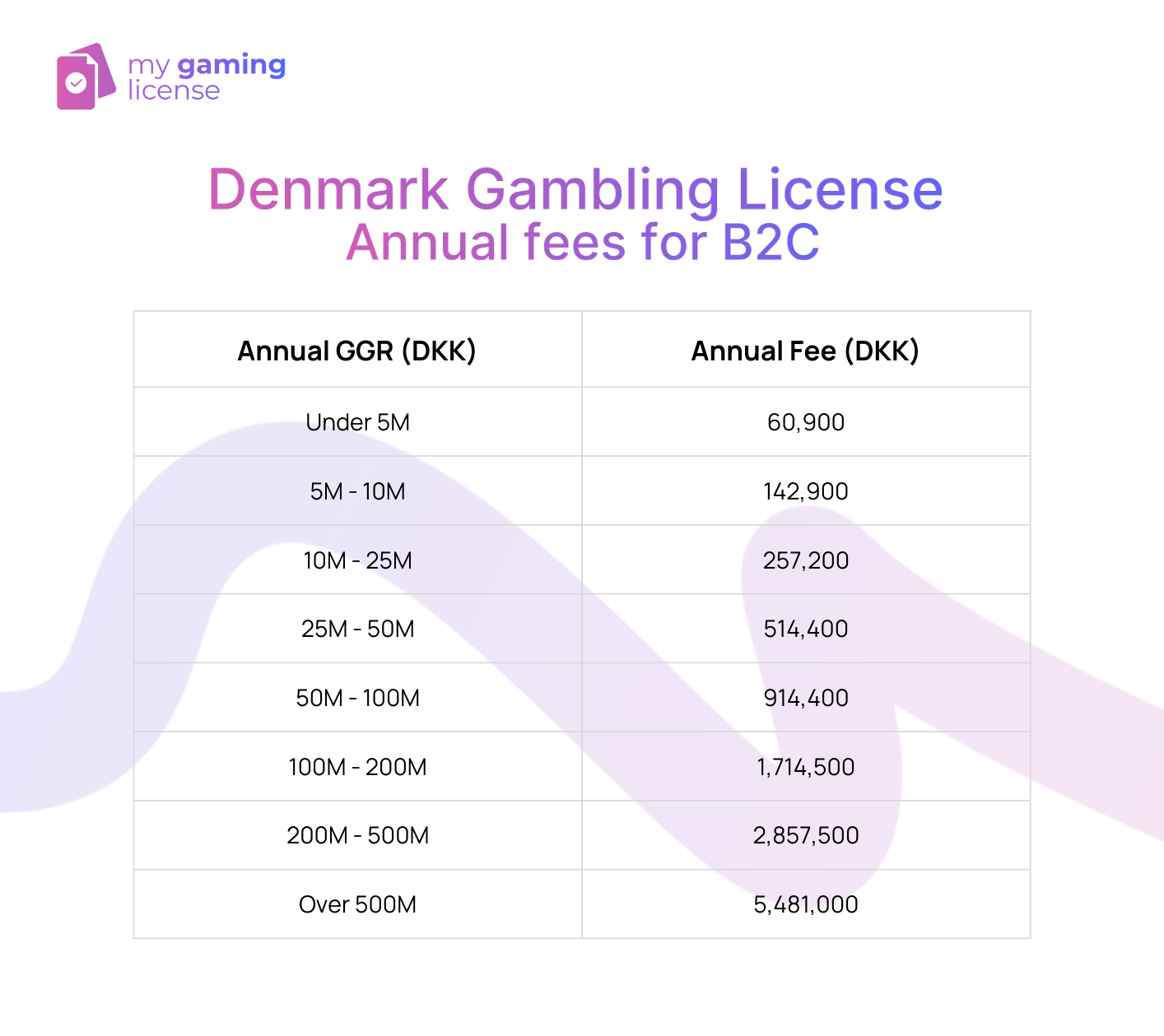 B2B suppliers are charged a fixed annual fee of DKK41,400. Additionally, operators face a 28% tax on GGR for online betting and casino activities, an increase from the 20% rate set in 2012. These costs should be factored into any financial planning.
Processing Time
The application process generally takes 3 to 6 months, depending on the completeness and complexity of the submission [3]. Submitting all required documents early and responding swiftly to follow-up requests can help speed up the process. Setting up a dedicated, set-off free account for player funds can also facilitate quicker approval.
B2B suppliers should be aware of new certification requirements coming into effect on July 1, 2025, and prepare their applications accordingly [3].
While understanding costs and timelines is crucial, operators must also navigate Denmark's strict regulations to ensure long-term success in the market.
Gambling Regulations in Denmark
Denmark has a well-regulated gambling industry, overseen by the Danish Gambling Authority (Spillemyndigheden). Through clear laws and strict enforcement, the country ensures gambling is conducted responsibly while minimizing financial crime risks.
Responsible Gambling
Denmark's gambling laws focus heavily on protecting players. Licensed operators are required to implement a range of measures, including:
Age verification to prevent underage gambling.
Mandatory deposit limits (daily, weekly, and monthly).
Integration with the ROFUS self-exclusion system.
Monitoring gaming patterns for unusual activity.
Providing access to problem gambling support services.
ROFUS (Register of Voluntarily Excluded Players) is a nationwide system allowing individuals to block themselves from gambling with all licensed operators. With over 30,000 participants, it plays a key role in safeguarding players [1].
Operators are also required to monitor players' behavior and intervene if problem gambling signs are detected. The Danish Gambling Authority has issued a guide emphasizing the need for temporary gambling suspensions for at-risk individuals [1].
Anti-Money Laundering (AML) Requirements
As of January 1, 2025, Denmark has introduced stricter anti-money laundering measures. Licensed operators must:
Appoint dedicated AML officers.
Perform due diligence on customers.
Monitor transactions for suspicious activity.
Keep detailed records of transactions.
Train staff on AML procedures.
For jurisdictions flagged as high-risk under EU regulations, Enhanced Due Diligence (EDD) is mandatory. This involves conducting more thorough risk assessments and applying stricter monitoring protocols.
Operators must integrate FATF's high-risk jurisdiction lists into their risk management processes to meet these standards.
Compliance with these regulations is essential for obtaining and renewing a Danish gambling license, ensuring operators stay competitive and meet the country's strict requirements.
Conclusion
Denmark offers a regulated and transparent gambling market, providing operators with a stable environment and clear guidelines. Starting in 2025, new B2B licensing requirements will take effect, requiring game suppliers to secure licenses to work with B2C operators. Applications for these licenses will open on September 1, 2024 [3].
The Danish Gambling Authority has built a reputation for strict enforcement, as demonstrated by its action against 55 illegal gambling websites in 2020. This proactive approach has helped maintain high compliance levels and earned player trust.
For operators, licensing costs range from DKK 304,500 to DKK 426,300, with annual fees tied to GGR. While not inexpensive, these fees reflect the maturity and strong regulatory framework of the market. Operators must also meet strict responsible gambling and anti-money laundering (AML) standards, which are key to Denmark’s balanced approach to business opportunities and consumer protection.
The licensing process, which generally takes three to six months, requires careful attention to technical, operational, and financial details. Partnering with legal experts familiar with Danish gambling laws can make navigating this process much smoother.
Denmark’s focus on responsible gambling and its evolving regulations continue to make it a strong choice for operators looking to grow in Europe’s regulated markets. With clear rules, a proven track record of enforcement, and ongoing improvements, the Danish gambling license remains a valuable option for those aiming to establish or expand their presence.
WHY MGL?
Here are 5 reasons why we are the best fit for your project
1 form
Just one form to fill out — we handle everything else.

30 Minutes
All we need from you to kickstart the process.

1-3 Days
Fast company formation so you can start using your business immediately.
6-7 Weeks
Get your casino licensed.







FAQ
We'll answer
any questions you have
Everything you need to know about Our company. Can't find the answer you're looking for? Please chat to our team.
Yes, non-residents can run gambling businesses in Denmark as long as they appoint a local representative and comply with all regulatory requirements.
To secure a license, operators need to:
- Show financial stability
- Use secure gaming systems
- Have strong operational controls
- Appoint a local representative if based outside Denmark or the EU/EEA
Starting July 1, 2025, game suppliers must obtain a B2B license, secure dual certification, and begin the application process by September 1, 2024.
Application fees range from DKK 60,900 to DKK 426,300, depending on the type of license. Annual fees are based on gross gaming revenue, starting at DKK 60,900 for revenues under DKK 5 million and going up to DKK 5,481,000 for revenues exceeding DKK 500 million.
The processing time usually takes between 3 to 6 months, depending on how complex the application is and whether all required documents are submitted on time.
Licensed online gambling operators in Denmark are subject to a 28% GGR tax. GGR stands for gross gaming revenue, calculated as total stakes minus winnings paid out to players.
Ready to start future online casino?
Navigating the gaming license process can be complex. Here's a streamlined guide to each step